

Welcome back :) This free newsletter contains a detailed market analysis video and 3 actionable stock trading ideas. Upgrade to get 20++ stock setups with a video trading plan discussed in the paid episode.
The premium video (58:57) focuses on:
Market Discussion
Discover the one thing that happened last Thursday that made me question my bearish stance for the first time in six weeks.
Watch the video from the WLGC session on 7 Apr 2026 to find out the following:
How to read the market’s reaction to bad news as a leading indicator.
How to spot a bullish divergence between price and breadth before a rally begins.
The two completely opposite outcomes at the 200-day moving average and how to tell which one is playing out.
Why buying “cheap” stocks during a market correction is one of the most dangerous strategies.
And a lot more.
Something Changed Last Thursday — And Most People Missed It
I’ve been bearish for six weeks straight. Diamond formation. Breadth collapse. Support levels falling like dominoes. Every call played out.
So believe me when I say this: something shifted last week.
The Rally Nobody Expected
The S&P 500 had broken below 6,550 and was sitting near 6,400. Everything pointed to the capitulation flush I’d been mapping toward 6,000–5,800.
Then the market bounced. Fine — bounces happen in downtrends.
But last Thursday is what got my attention.
Trump gave a speech. No resolution on the war with Iran. Confused messaging from both sides. Oil near the highs. Every headline screamed bearish.
The market gapped down hard in the pre-market. I genuinely thought that was the rejection candle — the one that kicks off the capitulation leg.
It wasn’t.
US session opened and buyers stepped in. Pushed it right back up. Left a demand tail that told a completely different story than the headlines.
That made me pause.
Bad News That Doesn’t Move The Market Is Information
There’s an old market principle most people know intellectually but struggle to apply in real time. When bad news fails to push prices lower, it’s bullish.
War ongoing. Iran retaliating. No diplomatic resolution. Oil elevated. Speech offered nothing reassuring.
And the market just... hovered. Then rallied.
Everyone who wanted to sell because of the war had already sold. The marginal seller was exhausted. When you run out of sellers, even mediocre demand pushes prices higher.
That’s what Thursday showed me. Not a buying frenzy. Just the absence of selling in the face of everything that should have triggered more of it.
Subtle difference. Massive implication.
The Bullish Divergence That Set This Up
The clue was already there before Thursday.
Short-term market breadth (refer to the video above) put in a higher low while the S&P 500 printed a lower low in price.
Price: lower low. Breadth: higher low. Classic bullish divergence.
In plain English — even as the index hit new lows, fewer stocks were participating in the decline. Under the surface, things were stabilizing while headlines still screamed doom.
Right after that divergence? The strong rally kicked in.
Doesn’t guarantee the bottom is in. Divergences can fail. But combined with Thursday’s refusal to sell off on terrible news, the weight of evidence was tilting.
The 200-Day Moving Average Decides Everything
The S&P 500 is rallying toward the 200-day moving average around 6,700. What happens there determines the next several weeks.
Bearish case: Carbon copy of April 2025. Market rallies to the 200-day, gets a sharp rejection, accelerates into the capitulation flush toward 6,000. Big bearish bar at 6,700, sellers step in aggressively, bottom drops out. We’ve seen this movie.
Bullish case: Market reacts at the 200-day — some profit-taking, some selling. But instead of a sharp reversal, it just pulls back mildly. Stabilizes. Pushes back through.
Maybe reaches 6,800. If it reclaims and holds 6,800? That’s not a bear market rally. That’s a structural recovery.
The difference comes down to one thing: how the market behaves at 6,700.
Big bearish bar with conviction? Bears win. Consolidation and absorption? Bulls win.
I don’t have the answer yet. The market will give it to us at 6,700.
Don’t Rush In
After six weeks of watching this market deteriorate, the moment something shifts, the urge to jump back in is overwhelming.
Resist that.
HOOD 0.00%↑ went from $150 to below $70. More than 50% drawdown. Looks cheap, right? But technically it’s still in a downtrend with no sign of aggressive demand. If the S&P gets rejected at the 200-day, stocks like this don’t just dip — they break support and find a whole new floor.
Down 30% can easily become down 60%. Wait for the setup. Wait for 6,700 to tell its story first.
The Honest Take
Truth be told, I’m conflicted this week. And I think that’s the right way to feel.
The bearish setup is still there. The macro backdrop is terrible. The technical damage is severe.
But the market is absorbing bad news instead of amplifying it. Breadth is improving from the bottom up. The rally off the lows is stronger than any previous bounce during this decline.
I’m not flipping bullish. But I’m no longer leaning as hard into the bearish camp as I was two weeks ago.
Watch 6,700. That one level tells us everything.
Trade Setups
19 actionable setups including VIAV 0.00%↑ DELL 0.00%↑ LWLG 0.00%↑ were discussed during the live session on 31 Mar 2026 before the market open (BMO).
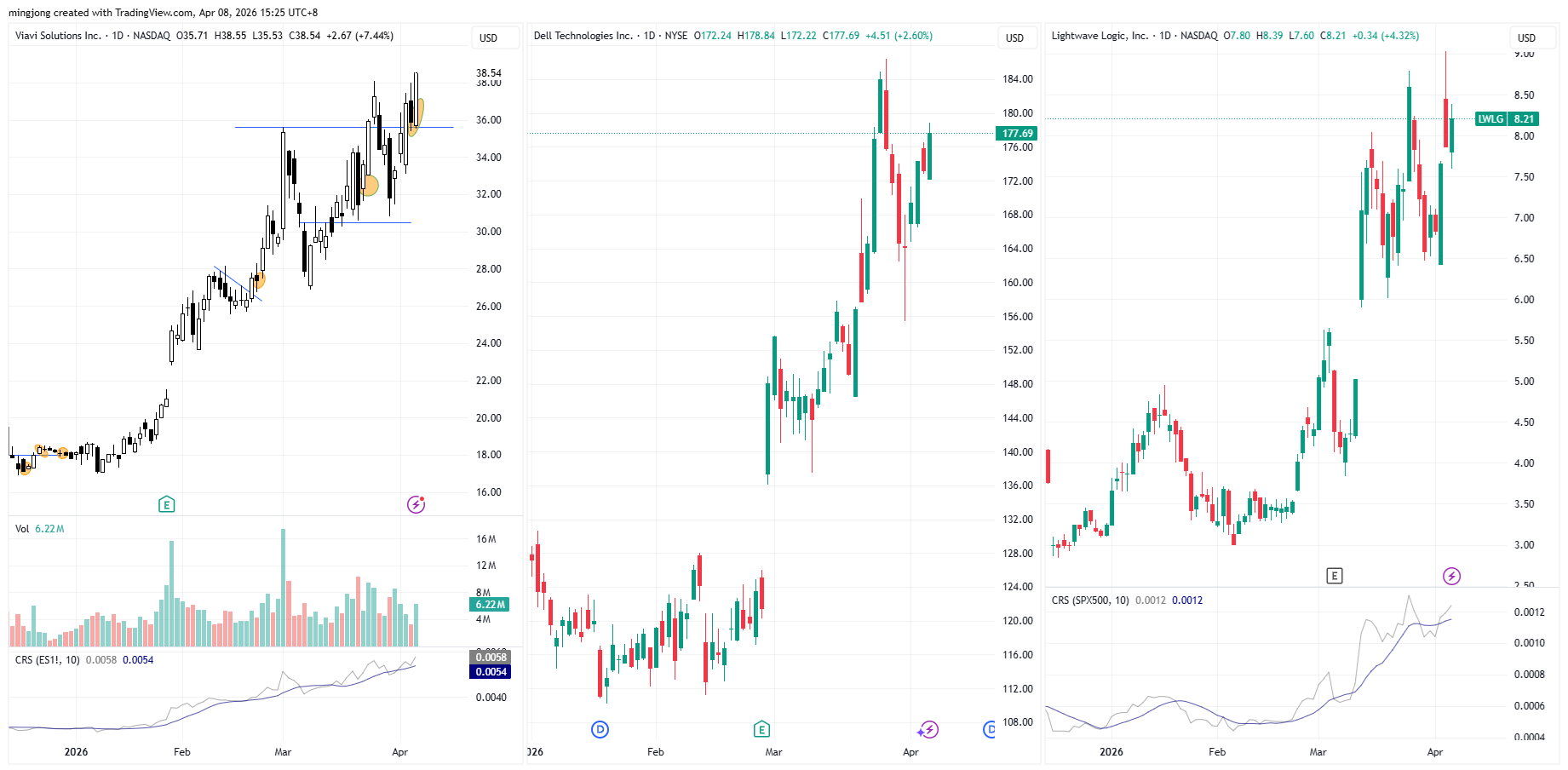
Watch 23 Grade A Trade Setups like above + How to take advantage of this Optical Photonic Value Chain Map
Layer 0 - Test & Measurement: KEYS 0.00%↑ VIAV 0.00%↑ FORM 0.00%↑ ONTO 0.00%↑ AEHR 0.00%↑
Layer 1 - Wafer Foundry/Packaging: TSM 0.00%↑ GFS 0.00%↑ TSEM 0.00%↑ AMKR 0.00%↑
Layer 2 - Materials & Substrates: GLW 0.00%↑ AXTI 0.00%↑
Layer 3 - Photonic Components & IC: MTSI 0.00%↑ LASR 0.00%↑ POET 0.00%↑ LWLG 0.00%↑ LPTH 0.00%↑ ALMU 0.00%↑ OPTX 0.00%↑
Layer 4 - Optical Systems/ Transceivers: CIEN 0.00%↑ LITE 0.00%↑ COHR 0.00%↑ FN 0.00%↑ AAOI 0.00%↑
Layer 5 - End system networking (Switches, routers, AI Fabric, GPU): NVDA 0.00%↑ AVGO 0.00%↑ ANET 0.00%↑ CSCO 0.00%↑ MRVL 0.00%↑


